
Overview
At GIBB, complexity forms part of our DNA. As a company operating in a deeply complex society, we understand the many elements that influence successful project delivery. The more moving parts there are to a project, the more we revel in creating integrated solutions that are responsive to a demanding environment.
Our large footprint, combined with the vast expertise of our people and more than 65 years of experience in the power, mining, water, transport, industrial, project finance & development, property and petrochemicals & energy markets in Africa, provides us with a profound understanding of the opportunities and challenges presented by complex projects on the African continent.
Combined with our multi-disciplinary approach, we are the right partner for project delivery. Through our subsidiaries and affiliates, we also partner with project developers and owners to finance early-stage project development in the water sector, undertake joint development of renewable energy projects and provide life cycle services, such as asset management and operations & maintenance of infrastructure projects.
1956 – 2005
(The multi-disciplinary approach)
(The multi-disciplinary approach)
GIBB’s story began in the United Kingdom in the 1900’s. By mid-2005, the firm retained its position as one of the largest black-owned firms in South Africa. The multi-disciplinary approach is still core to the business today and continues to reap rewards.
2005 – 2010
(The first five-year strategy)
2005 – 2010
(The first five-year strategy)
This period marked the implementation of the first five-year strategy, with a major change in the structure of the team. GIBB was one of the first firms in the sector to develop and implement the new paradigm for broad-based employee ownership models. To date, the model still forms the core of GIBB’s ownership structure.
2011 – 2016
(Five more years of focused strategy implementation)
(Five more years of focused strategy implementation)
In line with the new strategy developed in 2011, the vision of GIBB evolved to becoming a world-class provider of infrastructure planning, design and delivery. A culture of achievement allowed GIBB to be the employer of choice for the best people.
Vision
A trusted creator of integrated solutions.
Mission
We exist to provide solutions that make a difference to the lives of others.
We aspire to be the leading partner in project delivery, operations, maintenance and where feasible, development and ownership in the power, mining, water, transport, property and oil & gas markets in Africa.
Our quest is to support our clients and partners in delivering on their mandates. We do this by, in addition, paying attention to matters beyond the technical solution.
Our promise to our staff and society is driven by the African philosophy of “Ubuntu”.
Our Values
- We are trustworthy
We believe that trust is core to forging lasting relationships.
- We are professional
We bring business integrity and the highest standards of knowledge to everything we do.
- We are insightful
We see beyond the technical solution and do our best to not only understand our clients and partners’ challenges, but to keep the ultimate end-users of our engineering solutions in mind.
- We are creative
We give ourselves the freedom to create, with a view to providing our clients with the most innovative and leading-edge solutions.
- We are collaborative
We believe that strong teamwork creates lasting solutions. Our ability to develop great projects is enhanced by our integrated approach and the various partnerships that we have created over the years.
Ownership and Management
GIBB has an ownership structure that is constituted of two trusts. The Broad-Based Ownership Trust owns 73.06% whilst the General Staff Trust owns 26.94%.
This qualifies GIBB as a truly 100% employee-owned African company, reaffirming its ethos of ensuring a broader and more meaningful participation of previously disadvantaged groups in South Africa’s active economy.
GIBB holdings board of directors
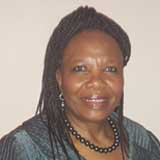
Nana Magomola
Chairperson

Sathiaseelan Gounden
Director of GIBB Holdings

Fatima Essa Morojele
Non-Executive Director

Richard Vries
Director

Mohammed Mayat
Director

Isabella Mathe Makutha
Non-Executive Director
GIBB Group Management
Richard Vries
Group CEO

Ntshavheni Phidza
General Manager: EPCM

Sean Molloy
General Manager: Transportation
Mohammed Mayat
Group Chief Financial Officer

Vernon Joubert
General Manager: Water and Infrastructure

Ramogodi Motoma
Managing Director: Ace GIBB

Jan Botes
General Manager: GIBB Mining and GIBB Power

Colin Logan
GIBB Project Finance and Development

Bheki Vilakazi
Managing Director SVAI

Our History
GIBB has a rich history spanning more than 60 years. The company is an agile African solutions provider of infrastructure planning, design and delivery.
GIBB was founded in 1956 by David Hill and Leo Kaplan as Hill Kaplan. Some 10 years later the company changed its name to Hill Kaplan Scott (HKS) when Quentin Scott joined the consultancy. In 1979 the company became known as Hill Kaplan Scott Incorporated. By 1981, the hallmark year of the company’s 25th anniversary, the company had ten branches, 227 staff and 8300 successfully completed projects.
In 1994 the country experienced what was arguably the most significant event in its relatively short history – a new democracy. This brought major changes, economically, socially and politically. HKS merged with international company LAWGIBB Group, based in Atlanta in the United States, to form HKS LAWGIBB. This move capitalised on the strengths of both companies and allowed the company to further expand its African footprint. A year later, the company changed its name to GIBB Africa and was recognised as the largest consulting engineering company in Africa.
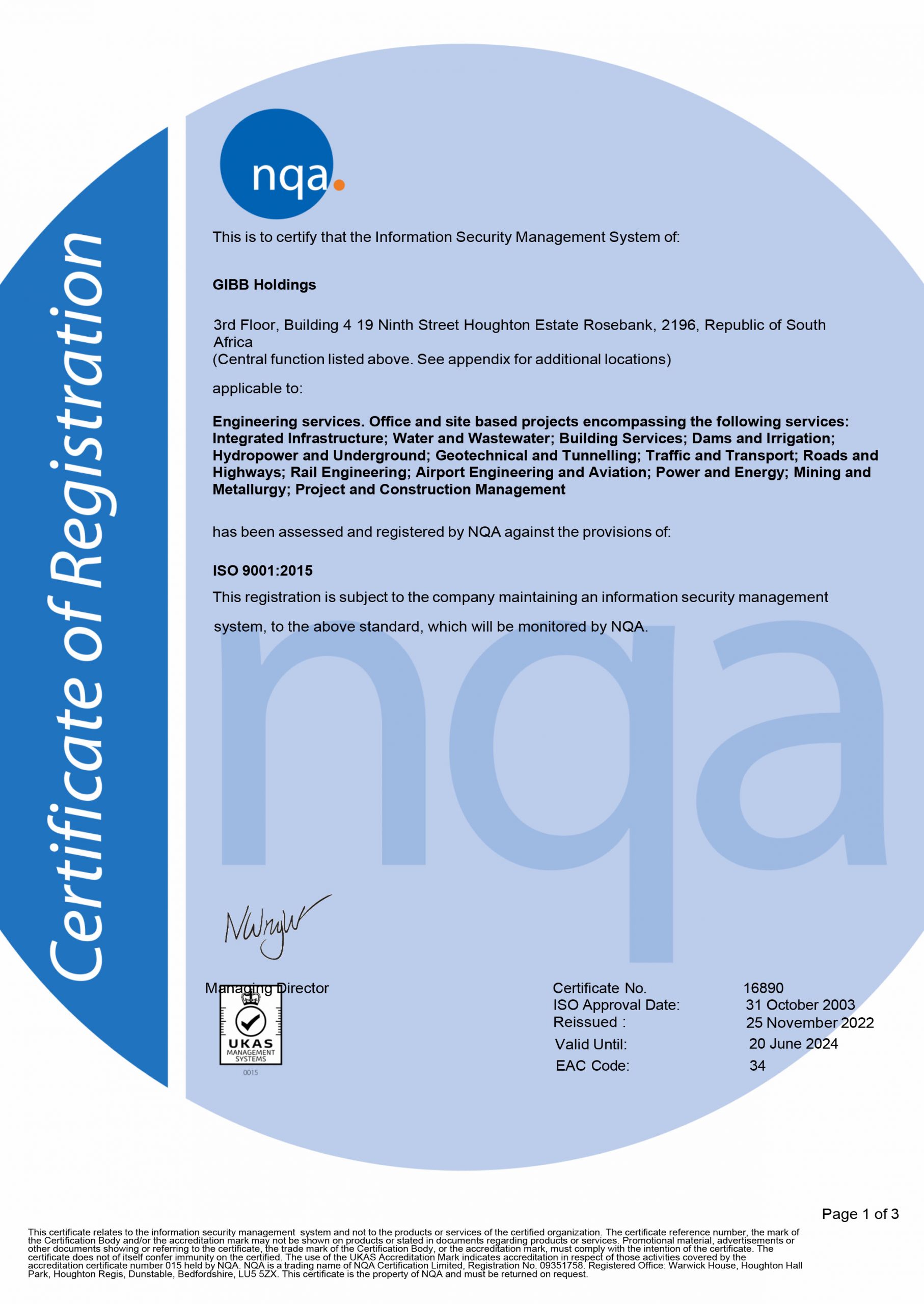
In 1999 the company was certified with ISO 9001 making GIBB Africa one of the first South African companies to embrace world-class quality. The company still maintains its certification for a successful quality management system.
During 2000 GIBB Africa underwent another transformation by merging with Cape Town-based Arcus Engineering resulting in a further name change to Arcus GIBB. Mr Tokyo Sexwale was appointed chairman of Arcus GIBB. In 2005 GIBB appointed its first female Director. It also welcomed a new CEO, Richard Vries, and continued the company’s transformation objective.
In 2006 Arcus GIBB celebrated its 50th anniversary and became 100% employee owned and 67% black employee owned as a result of two employee trusts in line with the Government’s Broad Based Black Economic Empowerment Act of 2003. GIBB was one of the first companies in the sector to develop and implement the new paradigm for broad-based employee ownership models. To date, the model still forms the core of GIBB’s ownership structure.
2012 saw GIBB achieve its Level 2 BBBEE status and the launch of a new slogan, “People Expertise Excellence” to embrace the new direction of the company.
Since 2010 GIBB has joined forces with companies to enhance its service offerings, namely urban and rural planning, environmental expertise, SVA International (architectural), and restructured the GIBB Group to form subsidiary companies, namely GIBB (Pty), GIBB Environmental, GIBB Mining and GIBB Power.
A new Chairman, Dr Don Mkhwanazi, was appointed in 2013 bringing with him a wealth of knowledge and experience to guide GIBB to becoming a world-class player in engineering services.
In 2017 Nana Magomola was appointed as the new Chairperson of GIBB Holdings (PTY) Ltd board, replacing the late Dr Don Mkhwanazi. Nana also serves as a non-executive member of the board.
In order to remain agile within changing economies and environments, GIBB in 2019 expanded their markets by including Mining and Oil & Gas with the existing services of Environmental, Power, Water, Industrial, Project Finance, Property and Transport. With the changes moving in the direction of fulfilling the company’s vision, in the same year, GIBB achieved its Level 1 BBBEE status.
In 2022 GIBB refined the service offerings in order to be best fulfil the markets in which it operates. Through their subsidiaries and affiliates, GIBB also partner with project developers and owners to finance early-stage project development in the water sector, undertake joint development of renewable energy projects and provide life cycle services, such as asset management and operations & maintenance of infrastructure projects. A culture of achievement has allowed GIBB to be the employer of choice for the best people talent.
In 2023 the GIBB BEE Staff Ownership Scheme Trust acquired 15 shares in the share capital of GIBB Holdings (Pty) Ltd, increasing its shareholding and GIBB becoming 73.06% black employee owned.
GIBB Group Awards
2020 - SAPOA Award for Innovative Excellence in the Retail Development
Small Boutique Category, Constantia Emporium
2020 - Connoisseur Circle Hospitality Award
Best Hospitality (Reader’s Choice), St. Regis Mauritius Resort
2019 - SAPOA Best Transformation Award, CTICC2
2019 - SAPOA Office Refurbishments Award, 33 Baker Street
2019 - Silver Arrow Award, SVA International
2019 - Standard Bank Top Women Awards Finalist
Finalist in the category Top Woman in Property awarded to Sandi Mbutuma – SVA International.

2019 - Standard Bank Top Women Awards Finalist
Finalist in the category Top Gender Empowered Organisation: Construction & Infrastructure Development awarded to GIBB.

2017 - Top 500 Awards Finalist Certificate
Top 500 Awards Finalist Certificate in the category Top 500 Best Managed Company in the General Industries Award awarded to GIBB.

2017 - Prism Awards; Bronze
PRISM Awards: Bronze award: Creating a GIBB Subject Matter Expert in the category Corporate Communication.

2017 - Certificate of Appreciation
GIBB received a Certificate of Appreciation by the International Heavy Haul Association.
2017 - Top 500 company survey by Topco Media
GIBB was ranked as the No 1 Consulting Engineering company in the 2017 Top 500 company survey by Topco Media.
2016 - Nyandeni Local Municipality Infrastructure Development
Nyandeni Local Municipality Infrastructure Development: Certificate of Recognition in appreciation for the best well established engineering consulting firm for 2015/16.

2016 - National Planning Award
National Planning Award by Ekurhuleni Metropolitan Municipality (EMM) for the best Municipal Plan.
2016 - Annual South African Institute of Civil Engineering (SAICE) Awards
The Ingula Pumped Storage Scheme in Little Drakensberg received two accolades at the 2016 Annual South African Institute of Civil Engineering (SAICE) Awards.
2016 - SACSC (South African Council of Shopping Centres) Award
SACSC (South African Council of Shopping Centres) Category B Award for the design and development of the Dainfern Square Project.
2016 - Top 500 Business-to-Business Directory
One of the Top 5 Companies in SA, in the Consulting Engineering Sector for Top 500 Business-to-Business Directory.

2016 - Professional Development Programme
Professional Development Programme – Certificate of Appreciation has been awarded to GIBB by the Western Cape Government for the Provision of training opportunities for candidates in the Professional Development Programme.

2016 - Runner Up Trophy: Best Exhibition Stand
Runner Up Trophy: Best Exhibition Stand – Africa Energy Indaba, Sandton Convention Centre, February 2016.
2015 - Deloitte Best Company to Work for Survey
Deloitte Best Company to Work for Survey: Silver Achiever Award.

2015 - ECA Presidential Excellence Awards 2015
ECA Presidential Excellence Awards 2015: GIBB won Electrical Installation of the year: Retail Gateway Shopping Centre, Malawi.
2015 - National Productivity Awards
Gold winner in the Corporate Sector for the National Productivity Awards 2015.
2015 - Productivity SA Awards Finalist
Productivity SA Award: GIBB received the Productivity Award for outstanding achievement in Productivity Improvement in the Corporate Sector.

2015 - Productivity SA Award
Productivity SA Award: GIBB received the Eastern Cape Productivity Award for outstanding achievement in Productivity Improvement in the Corporate Sector.
2015 - Best Informal Settlement Upgrade in KwaZulu-Natal
Best Informal Settlement Upgrade in KwaZulu-Natal: Groutville Priority 5 Housing Project; KwaDukuza Local Municipality.
2015 - PRISM Awards; Bronze
PRISM Awards SA, Bronze Award presented to GIBB for its campaign Owning the Conversation in the category Corporate Communications.

2014 - PRISM Awards; Silver
PRISM Awards SA, Silver Award presented to GIBB for its campaign Growing the GIBB Brand in the category Corporate Communication.

2014 - SAPSA Engineering Firm of the Year
SAPSA (South African Professional Services Awards): Engineering firm of the Year.

2014 - Top 500 Companies 1st Place; Consulting Engineers Sector
Top 500 Companies – GIBB was awarded 1st place in the Consulting Engineers Sector of the 2014 Top 500 company survey by Topco Media – which ranks South Africa’s most successfully managed companies.

2014 - CESA Aon Runner-up Job Shadow Initiative
CESA Aon Engineering Excellence Awards Runner-up in the Job Shadow Initiative.

2014 - Bridge City Rail Link: Highly Commended for Technical Excellence
The South African Institution of Civil Engineering hereby certifies that the Bridge City Rail Link was highly commended for Technical Excellence at the Durban Branch Awards.

2014 - BBQ Awards First Runner-up
BBQ Awards – GIBB was the First Runner-up at the South Africa’s Premier Black Business Awards for Trade & Investment KwaZulu-Natal Best Established Black Business Award.

2013 - Impumelelo, Top Empowered Companies
Impumelelo; This is to certify that GIBB has qualified as one of South Africa’s Top Empowered Companies.
2013 - CESA Engineering Excellence Awards Commendation
CESA Aon Engineering Excellence Awards Commendation on Projects with a value of between R50 and R250 million awarded to GIBB for The rehabilitation of East London Airport Project for Airports Company South Africa.

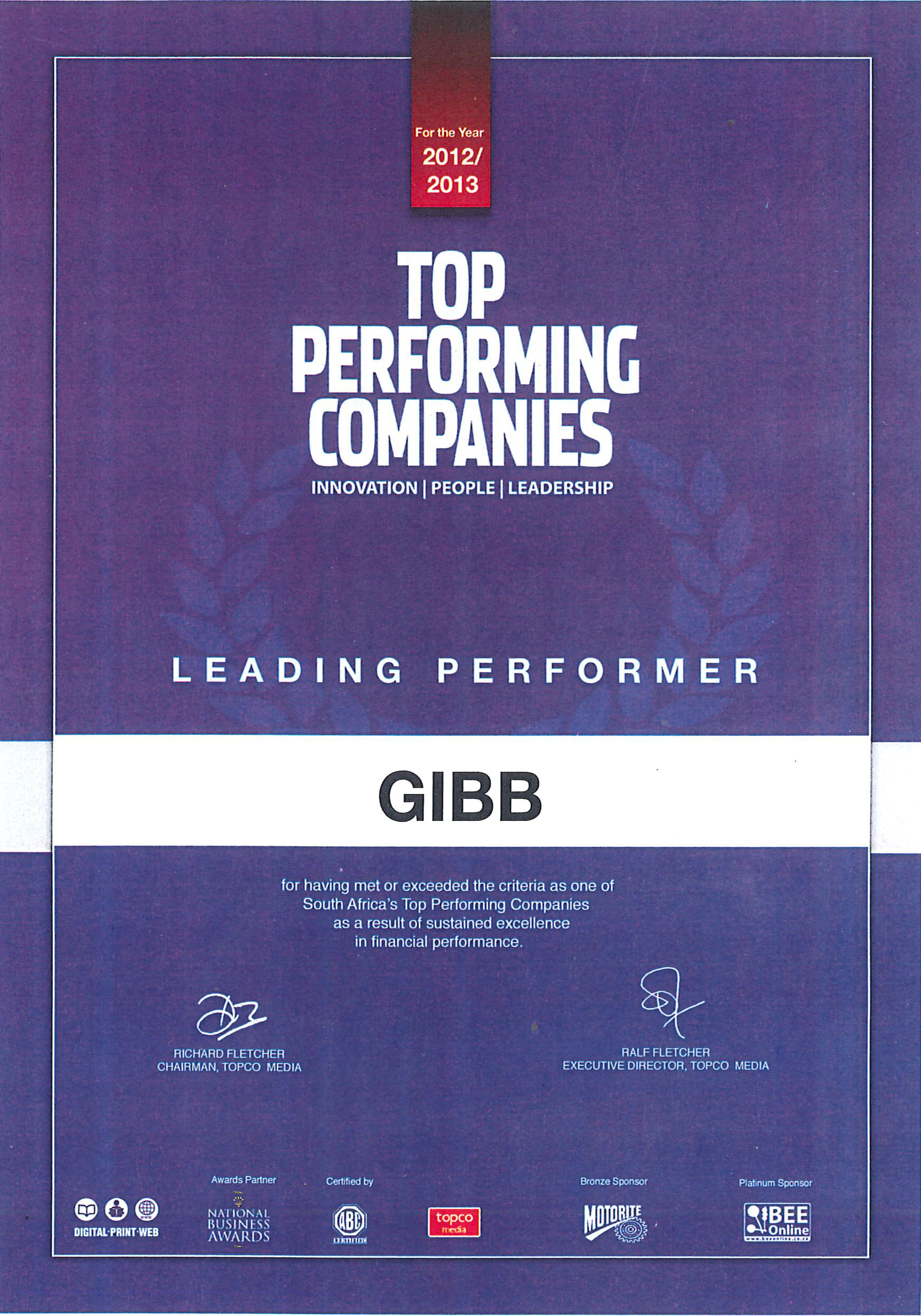
2012/13 - Top Performing Companies Leading Performer
GIBB was awarded the Leading Performer by the TOP PERFORMING COMPANIES for having met or exceeded the criteria as one of South Africa’s Top Performing Companies as a result of sustained excellence in financial performance.
2012 - Top 500 Companies 1st place in the Consulting Engineers Sector
Top 500 Companies – GIBB was awarded 1st place in the Consulting Engineers Sector of the 2012 Top 500 company survey by Topco Media – which ranks South Africa’s most successfully managed companies.

2012 - CESA Job Shadow Month Winner
CESA Job Shadow Month Winner.

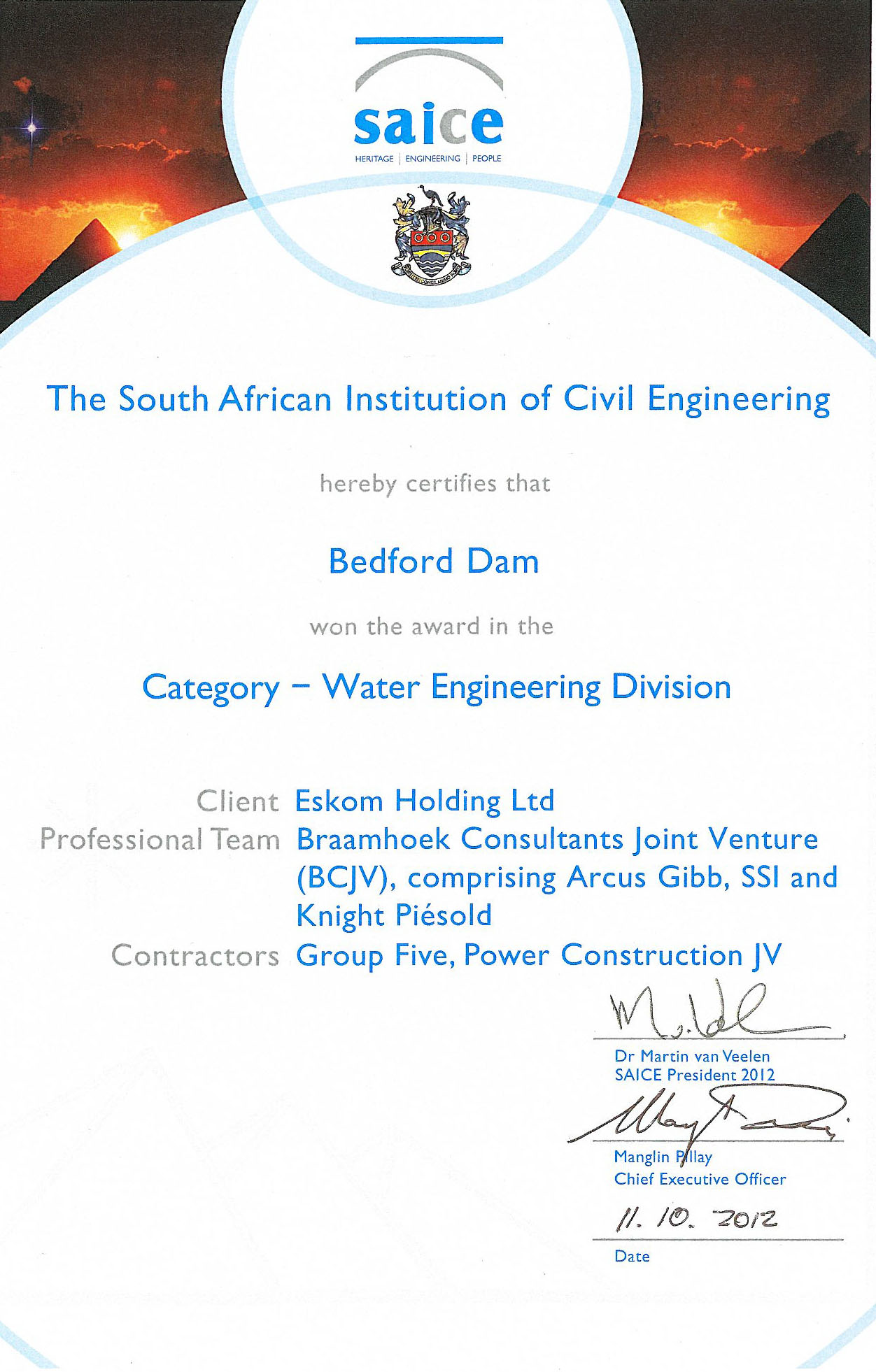
2012 - SAICE Bedford Dam Award
The South African Institution of Civil Engineering hereby certifies that Bedford Dam won the award in the Category – Water Engineering Division.
2011 - CESA Job Shadow Month Winner
CESA Job Shadow Month Winner.

2011 Finalist Certificate of Excellence
Metropolitan Oliver Empowerment Awards – 2011 Finalist Certificate of Excellence – Basic & General Industries.

2010 - Golden Arrow Award – Winner
Project Management Review Golden Arrow Award – Winner Western Cape Top Engineering Consulting Firm.

2010 - Impumelelo Innovations Award Trust (Star Award)
Impumelelo Innovations Award Trust (Star Award) – Award for reclaimed Asphalt Paving Project. 2010 Sustainability Awards.

2010 - ESA Glenrand MIB Engineering Excellence Awards
ESA Glenrand MIB Engineering Excellence Awards: Soccer Stadiums category – Cape Town Stadium received a commendation (2nd place) in this category, for Structural Joint Venture submission, of which GIBB was a member.

2010 - ESA Glenrand MIB Engineering Excellence Awards
CESA Glenrand MIB Engineering Excellence Awards – Winner of ‘Projects Between R10 million and R100 million’. This was for GIBB’s work on the illumination of the new Cape Town Stadium.

2009 - Top Performing Companies Incorporating the Public Sector
Top Performing Companies Incorporating the Public Sector (as a result of its sustained excellence in corporate performance).

2009 - Top 500 South Africa’s best Companies
Top 500 South Africa’s best Companies (for contribution to the growth of the economy and job creation).
2009 - Impumelelo – SA’s Top Empowerment Companies
GIBB received a nomination from Impumelelo, SA’s Top Empowerment Companies as one of South Africa’s Top Empowered Companies as a result of its contribution to Broad-Based Black Economic Empowerment & Transformation.

2007 - Impumelelo - SA’s Top 300 Performing Empowerment Companies
Impumelelo – SA’s Top 300 Performing Empowerment Companies for Contribution to Broad-based Black Economic Empowerment and Transformation.

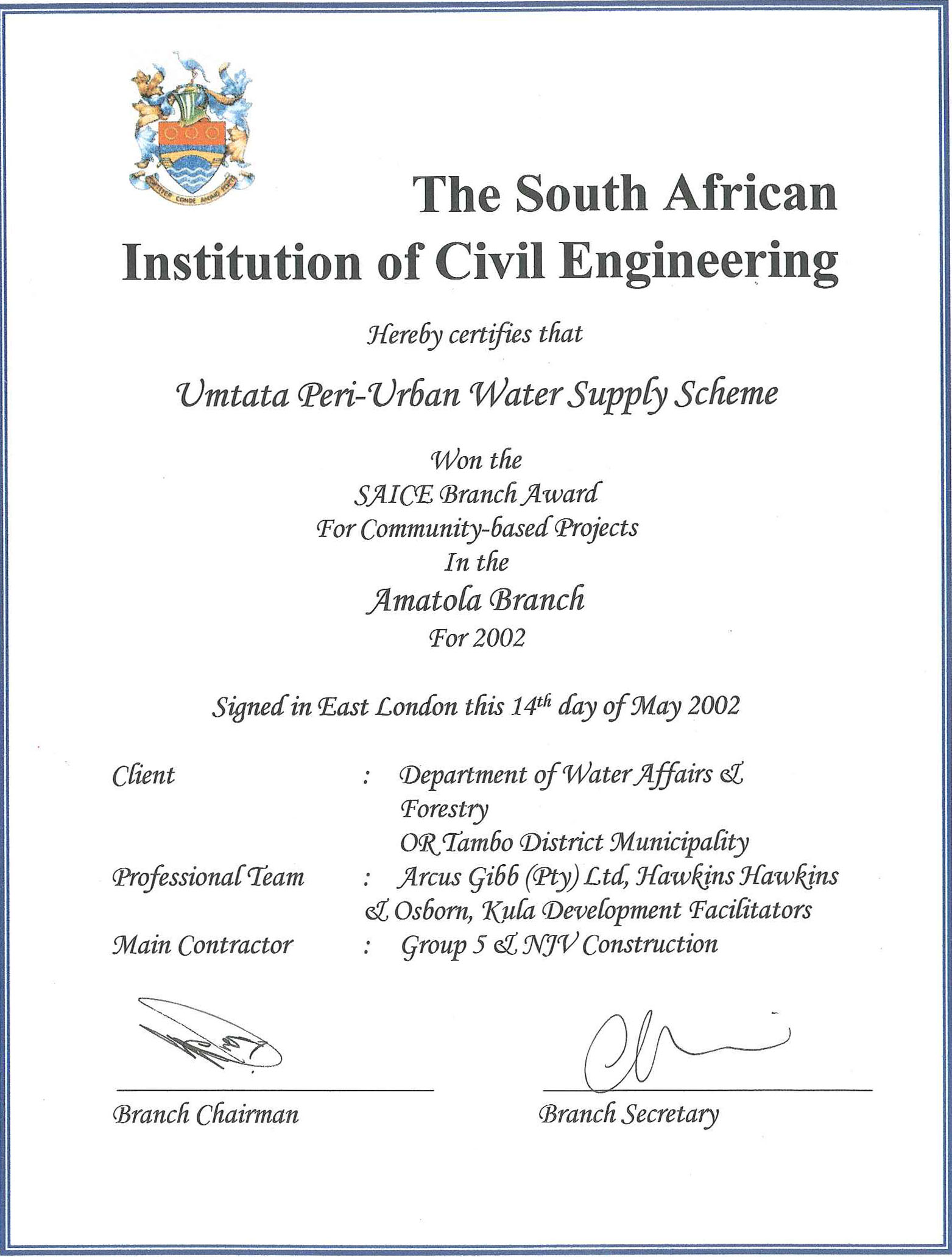
2002 - Winner SAICE Branch Award for Community Based Projects
SAICE Annual Branch Award, Amatola Region for Umtata Peri-Urban Water Supply Scheme.
Transformation
GIBB’s B-BBEE initiatives are anchored into the following pillars:
Employment Equity
GIBB continues to transform the company and employee profile at every level, as per the employment equity plan, to reflect the demographic representation of South Africa across race and gender.
Skills Development
GIBB creates capacity in the broader industry through promoting and investing in education and skills development.
Employee Development
On-going training and skills development is critical to GIBB within an operating environment characterised by a shortage of engineering skills. GIBB recognises the long term benefits of keeping employees motivated and adept. GIBB is committed to providing opportunities for further education, learning and development activities.
Enterprise Development
GIBB recognises the need to invest in Small Enterprises that could support large complex projects in the engineering consulting sector. GIBB is therefore committed to addressing this challenge through our Enterprise Development Programme.
Certificate for Quality Management
ISO 9001 is the internationally recognised standard for Quality Management Systems (QMS). It is the most widely used QMS standard in the world, with over 1.1 million certificates issued to organisations in 178 countries.
ISO 9001 provides a framework and set of principles that ensure a common-sense approach to the management of our organisation to consistently satisfy clients and other stakeholders. In simple terms, it provides the basis for effective processes and effective people to deliver an effective product or service time after time.
Click on the Image to view our Certificate of Quality Management
Partnerships and Affiliations
GIBB is affiliated to various professional and industry bodies.
Subsidiaries
Corporate Social Investment


GIBB is a proudly South African employee-owned company that embraces the principles of sustainable transformation, diversity and inclusiveness. At GIBB, we believe that sustainable transformation must go beyond mere compliance. It is about winning the hearts and minds of our people and our communities with whose development we are fully engaged. We are fully committed to strengthening the national business landscape – and through this, our country.
This commitment is evident from projects in which GIBB staff are involved or support:
– Community education and training
– Career guidance for science initiatives in schools
– Development programmes for youth and other target groups
– Conservation projects, community clean up, food projects and garden initiatives
– Community clinics and health programmes in the community
GIBB has a dedicated national CSI Committee with representation in all our major offices across the country. The responsibility of the committee is to comply with the CSI guidelines, assess new initiatives and support and monitor progress.
CSI is at the heart of what GIBB stands for: putting people first and building our country.